Non-Abelian Mixer for QAOA on Hybrid Oscillator-Qubit Quantum Processors
Abstract
The realization of universal control in hybrid oscillator-qubit quantum processors enables the systematic design and implementation of quantum algorithms. However, the algorithmic development for such platforms remains at an early stage. While the Quantum Approximate Optimization Algorithm (QAOA) has been extensively studied in both continuous-variable (CV) and discrete-variable (DV) quantum systems, its development in the hybrid CV-DV setting remains limited. In this paper, we propose a hardware-native non-Abelian mixer for QAOA on hybrid CV-DV quantum processors and develop a corresponding hybrid ansatz for the Max-Cut problem. We evaluate the proposed ansatz on unweighted Erdős–Rényi graphs and benchmark it against the standard transverse-field mixer using the approximation ratio and optimal-solution probability. Across all graph sizes and Fock cutoffs in our simulations, the proposed non-Abelian mixer consistently improves both expected solution quality and the probability of sampling an optimal solution relative to the transverse-field mixer.
Executive summary
The authors port QAOA to hybrid continuous-variable / discrete-variable (CV-DV) hardware (think superconducting cavities + transmon ancillas) and propose a new non-Abelian mixer built from conditional displacements along the non-commuting x̂ and p̂ oscillator quadratures, with GKP-encoded logical qubits providing the computational basis. On unweighted Erdős–Rényi Max-Cut instances (N=4,5), the mixer consistently beats the standard transverse-field mixer — mean approximation ratio improves by ≈0.13 and optimal-solution probability by ≈0.155 across all tested Fock cutoffs. For Yuan, this is a direct method overlap with Y1 (QAOA on Max-Cut) and Y2 (hard / constraint-aware mixer design), opening a credible CV-DV avenue for warm-started or iterative variants in future work.
Main contribution
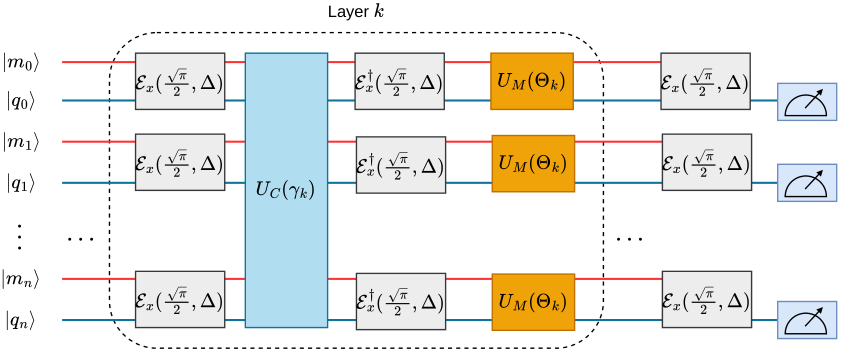
The paper introduces (i) a hardware-native non-Abelian QSP (NA-QSP) mixer composed of alternating conditional displacements CD(iβₓ, σ_φₓ) and CD(β_p, σ_φ_p) interleaved with single-qubit X-rotations on each oscillator–qubit pair, and (ii) a full hybrid CV-DV QAOA layer in which GKP-encoded logical states are coupled to ancilla qubits via the non-Abelian readout operation 𝓔ₓ(√π/2, Δ), the Max-Cut cost unitary U_C(γₖ) is applied on the ancilla register as a product of logical R_ZZ gates, and the inverse operation transfers phases back to the GKP modes before the local mixer acts. At depth d=0 the mixer reduces to the transverse-field baseline; at d≥1 it exploits the non-commutativity of [x̂, p̂] to generate richer dynamics on the encoded state manifold.
Key algorithms / building blocks
- Local non-Abelian mixer (Eq. 7):
U_M^(i)(Θₖ) = R_X(2β₀) Π_l [CD(iβₓ^(l), σ_φₓ^(l)) R_X(2θₓ^(l)) CD(β_p^(l), σ_φ_p^(l)) R_X(2θ_p^(l))]. Trainable parameters per layer:{β₀, βₓ, φₓ, θₓ, β_p, φ_p, θ_p}, shared across all oscillator-qubit pairs. - Hybrid QAOA layer (Eq. 11):
U_k = U_M(Θₖ) · (⊗_i 𝓔ₓ^†) · U_C(γₖ) · (⊗_i 𝓔ₓ), with a final𝓔ₓbefore Z-basis readout on the ancillas. - GKP logical readout with non-Abelian precorrection:
𝓔ₓ(√π/2, Δ) = e^{i√π p̂ Δ² Y} e^{i(√π/2) x̂ X}, where the prefactor compensates for ancilla-rotation errors induced by the finite envelope Δ. - Cost unitary:
U_C(γ) = Π_{(i,j)∈E} R_ZZ^(i,j)(−γ), synthesized via oscillator-mediated closed phase-space trajectories. - Optimizer: multistart COBYLA over the variational parameters.
Detailed walkthrough
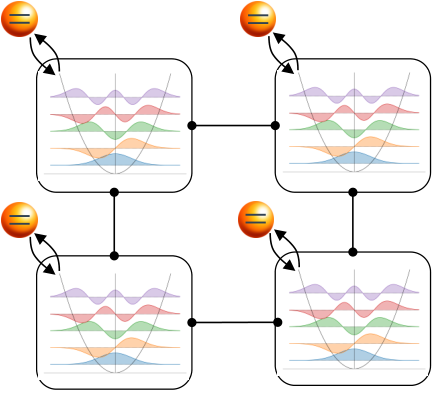
Section §II lays out the phase-space ISA for hybrid CV-DV processors: each oscillator mode is described by quadratures x̂, p̂ with [x̂, p̂] = i/2, and the elementary primitives are single-qubit rotations R_n̂(θ) and conditional displacements CD(β, σ_φ) = exp[(β↠− β*â) ⊗ σ_φ] coupling an ancilla qubit to a bosonic mode. The qubit-only logical R_ZZ gate, needed for the Max-Cut cost unitary, is synthesized via oscillator-mediated closed phase-space trajectories. Logical qubits are encoded in finite-energy GKP codewords |0⟩_GKP, |1⟩_GKP with envelope parameter Δ (smaller Δ → sharper but higher-energy peaks).
Section §III is the methodological heart. The key insight is that with non-Abelian QSP one can build a mixer that is not simply a sum of transverse-field X_i terms but instead a sequence of alternating x̂- and p̂-coupled conditional displacements (Eq. 7). The mixer is local (acts on each (m_i, q_i) pair) but the parameter set Θ_k is shared across pairs within a layer; at depth d=0 it collapses to e^{−iβ₀ Σ_i X_i}, reproducing the standard QAOA mixer. The complete circuit (Fig. 2 / Eq. 11) interleaves the readout map 𝓔ₓ(√π/2, Δ) that lifts the GKP logical info into the ancilla register, applies U_C(γ_k), transfers the relative phases back via 𝓔ₓ†, and then mixes via U_M directly on the oscillator phase space.
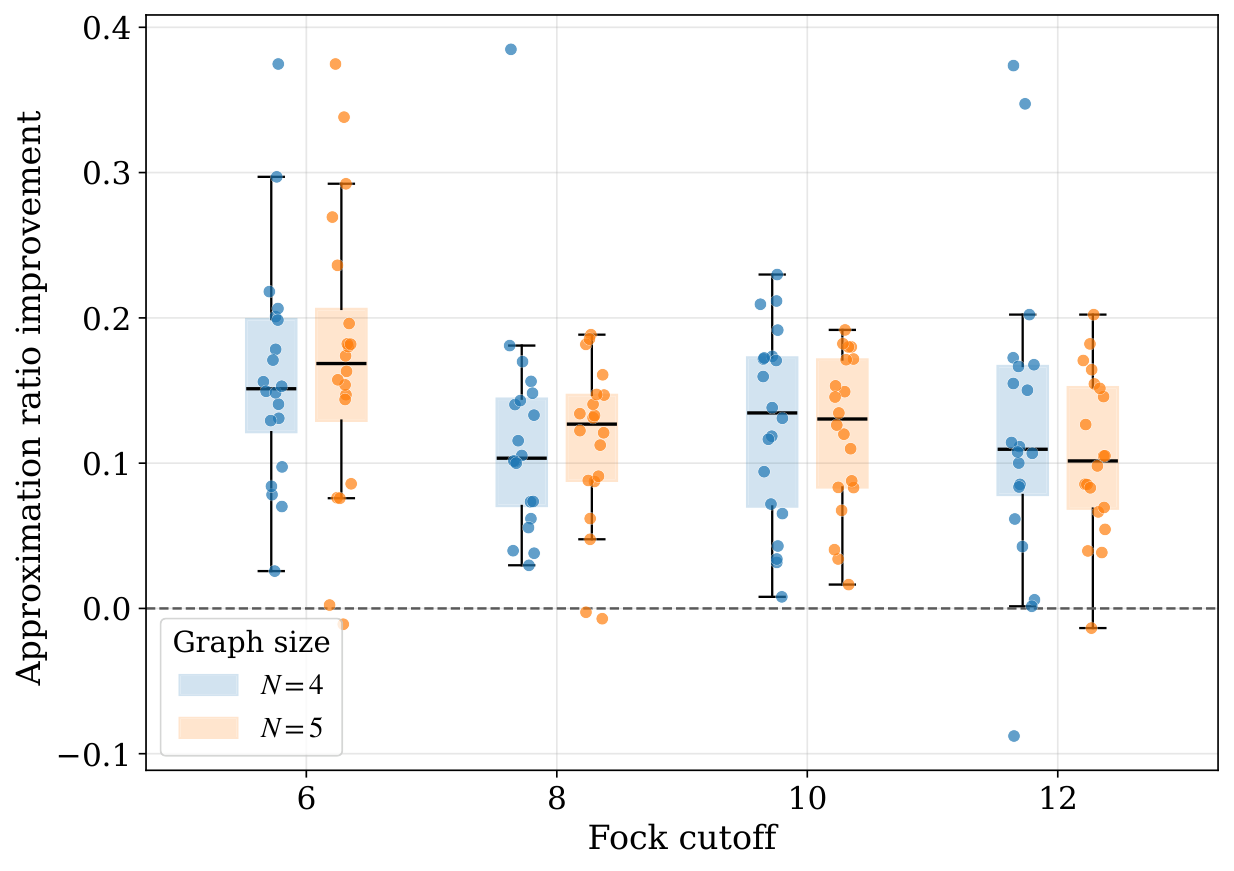
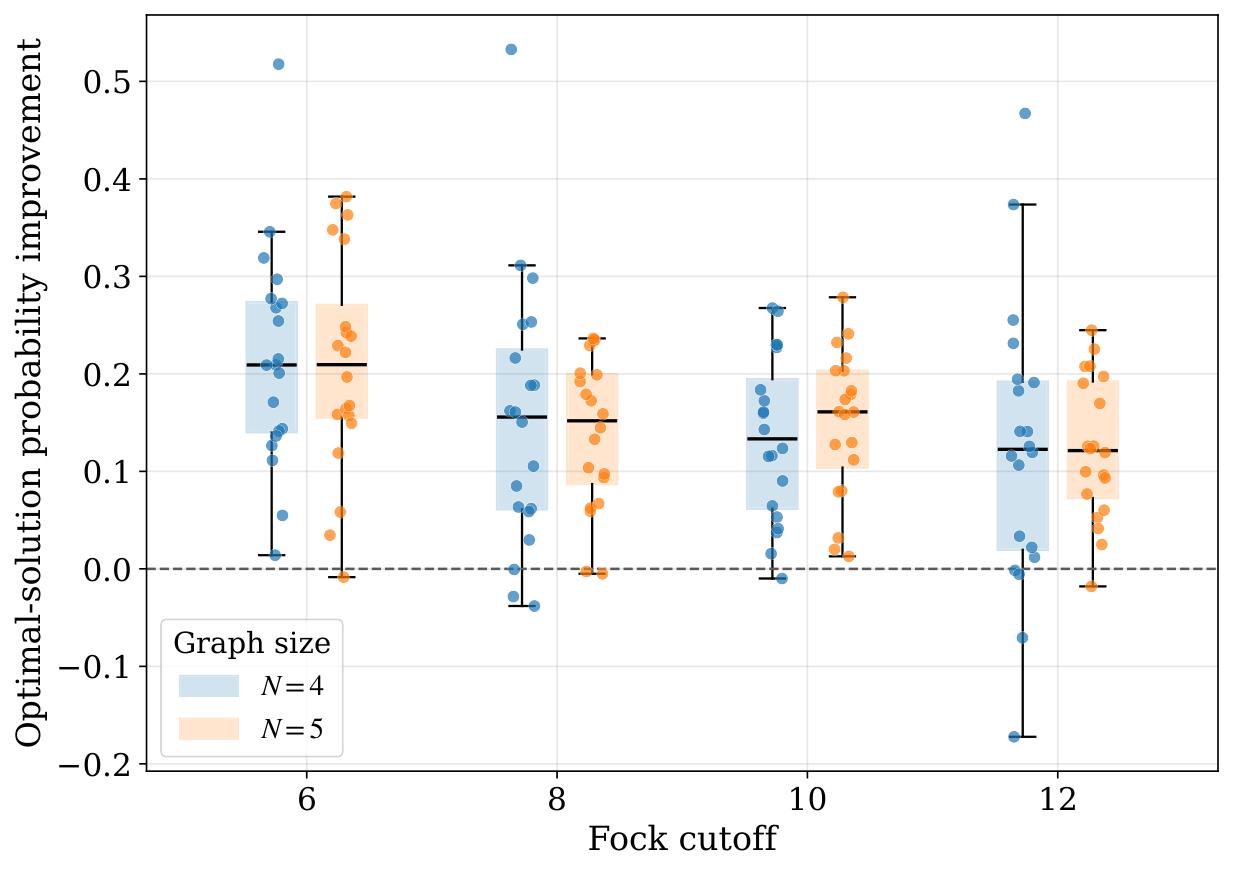
Section §IV reports the numerics. Setup: Erdős–Rényi graphs with edge probability 0.5, sizes N∈{4,5}, Fock cutoffs N_max∈{6,8,10,12}, QAOA depth P=2, mixer depth d=2, 20 random graph instances per (N, N_max). Two metrics: approximation ratio ⟨H_C⟩ / max_z ⟨z|H_C|z⟩ and optimal-solution probability P_opt = Σ_{z: C(z)=C_max} Pr(z). The headline results (§IV-B): the NA-QSP mixer yields a positive improvement in every (N, N_max) cell; averaged across cutoffs, the mean approximation-ratio improvement is ≈0.132 for N=4 and ≈0.128 for N=5, with corresponding P_opt improvements of ≈0.156 and ≈0.155.
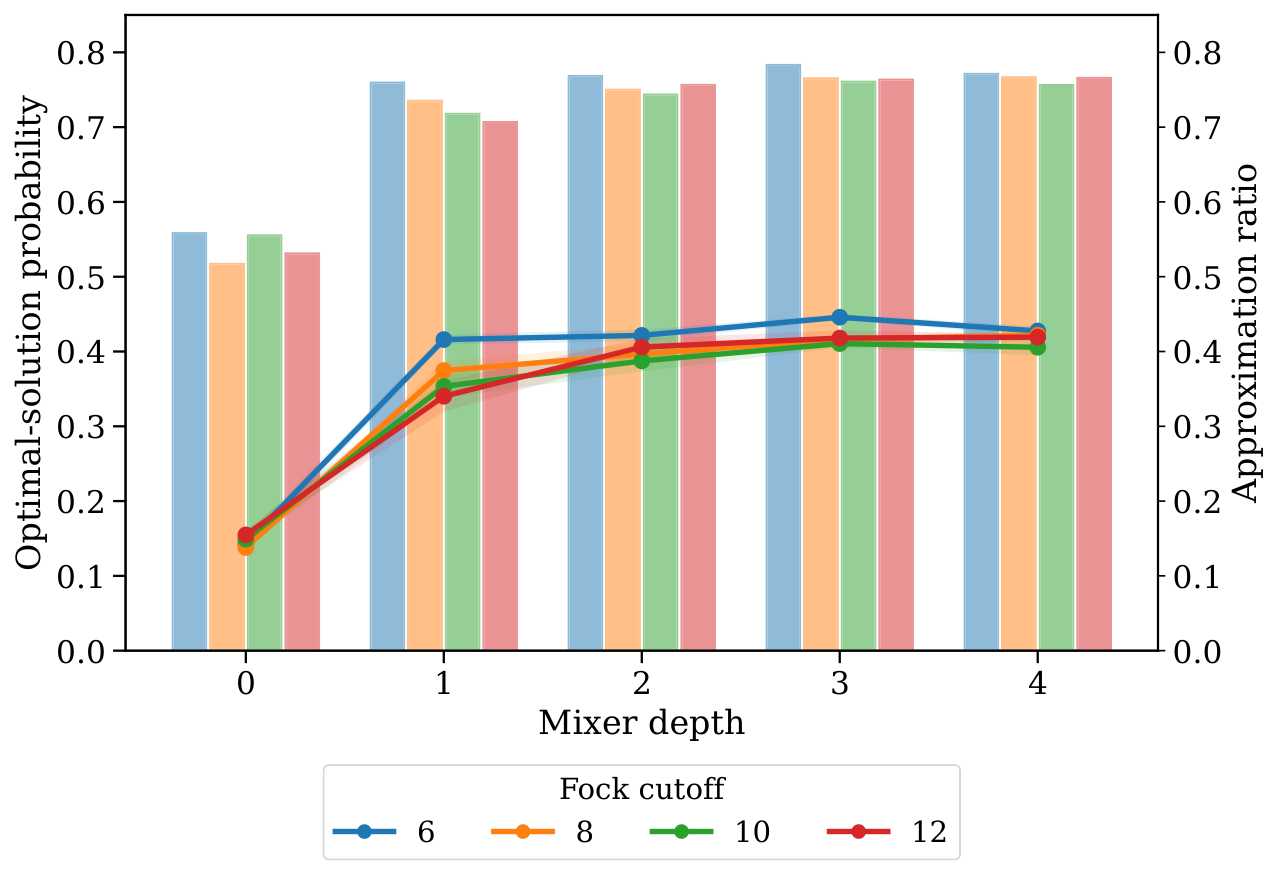
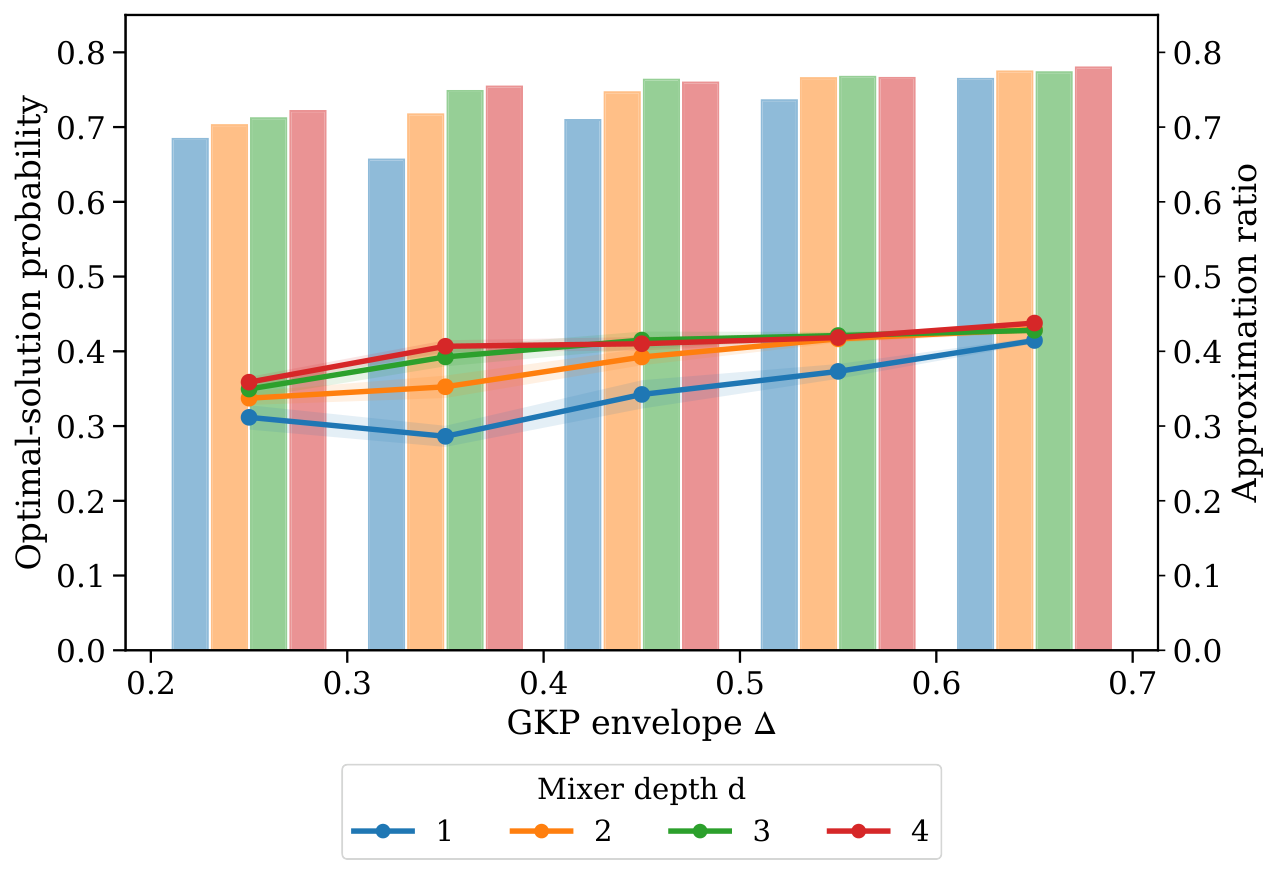
Section §IV-C analyses the effect of mixer depth d and envelope Δ. The most dramatic gain happens at d=0 → d=1: at N_max=10 the mean P_opt jumps from 0.149 to 0.353 and the approximation ratio from 0.555 to 0.718. Further depth gives only marginal improvement, and at fixed depth performance saturates with N_max once the truncation is large enough. Larger Δ helps slightly (mean P_opt ≈0.438 at Δ=0.65, d=4) because broader GKP states are easier to represent in a truncated Fock space.
The conclusion (§V) frames the result as a design principle: algorithms on hybrid CV-DV hardware should exploit the native phase-space ISA rather than mimic qubit-only constructions. Future work flagged: more expressive non-Abelian mixers, trainability vs. depth, and larger problem instances.
Figures
Citations to Yuan's papers
Overlap with Y1–Y6
- Y1 (warm-started QAOA on 3-regular MaxCut): Direct method-and-scope overlap. Both papers run QAOA on unweighted graphs (here ER with p=0.5; Y1 focuses on 3-regular). Y1 improves the cost-function landscape through measurement-based warm-starting; this paper improves it through a richer mixer that exploits CV degrees of freedom. They are complementary axes — one could imagine combining warm-starting (initial state preparation) with a non-Abelian mixer (transition operator).
- Y2 (quasi-binary encoding + hard mixer for portfolio QAOA): Conceptual parallel on mixer design. Y2's quasi-binary mixer preserves a hard cardinality constraint; the NA-QSP mixer here is unconstrained but exploits hardware-native non-commutativity. The shared lesson is that the mixer choice is at least as important as the cost circuit when chasing better approximation ratios.
- Y3 (DGMVP portfolio QAOA, layerwise + dual annealing): The optimization side (multistart COBYLA over 2-layer QAOA) is shallower than Y3's layerwise scheme; an interesting follow-up would be to apply Y3's layerwise optimisation to the deeper NA-QSP mixers proposed here, since the authors already note marginal gains beyond d=1 and trainability is a flagged open question.
Recommended action for Yuan
- Read & bookmark as a method paper. The mixer construction (Eq. 7) is small enough to read in detail and re-derive — worth flagging in any future warm-start-CV-DV crossover work.
- Consider a follow-up project: warm-starting on hybrid CV-DV. Y1's measurement-based warm-start could be lifted to GKP-encoded logical qubits; the NA-QSP mixer would provide the transition operator. This is genuinely novel ground.
- Cite in the related-work section of any future QAOA-on-non-standard-hardware paper (CV, bosonic, hybrid).