Detrimental Agnostic Entanglement: The Case Against Hardware-Efficient Ansätze for Combinatorial Optimization
Abstract
Variational quantum algorithms (VQAs) for combinatorial optimization routinely employ entangling gates as a default design choice, yet the role of entanglement, in its amount and structure, remains poorly understood. This gap is particularly consequential for problems governed by diagonal Hamiltonians, whose ground states are classical product states and therefore require no entanglement in principle, raising the fundamental question of whether and how entangling gates help or hinder the variational search. We investigate this question for MaxCut by introducing two complementary control mechanisms that provide smooth, monotonic control over hardware-efficient ansatz (HEA) entanglement as quantified by the Meyer–Wallach measure Q, and by benchmarking against QAOA as a problem-structured reference. Tracking the entanglement trajectory Q(t) throughout VQA training reveals that when the ansatz grants the optimizer indirect control over entanglement through its parameters, it consistently drives entanglement down. In line with this tendency, a fully separable ansatz outperforms all entangled hardware-efficient configurations, establishing a monotonic relationship: less problem-agnostic entanglement yields better performance. In contrast, QAOA, whose entanglement is structurally derived from the problem Hamiltonian, maintains high entanglement yet achieves competitive solution quality, demonstrating that entanglement structure, not merely quantity, determines its utility.
Executive summary
Rohe et al. ask a sharp question: for combinatorial-optimisation VQAs with diagonal cost Hamiltonians (whose ground states are product states), does any entanglement help? They construct two complementary control mechanisms — progressive CNOT deletion and controlled-rotation (CRot) parameter restriction — that smoothly tune the Meyer–Wallach entanglement Q in a hardware-efficient ansatz (HEA), then benchmark against QAOA on MaxCut. The empirical finding is striking: less agnostic entanglement → better HEA performance, monotonically. A fully separable ansatz beats every entangled HEA configuration. QAOA, by contrast, stays high-Q during training yet matches the best HEA — confirming that entanglement structure (not amount) is what matters. For Yuan, this is a direct empirical counterweight to the implicit assumption that warm-started entangling QAOA is the "default" — the paper validates QAOA's problem-structured entanglement while undermining the hardware-efficient ansatz family entirely.
Main contribution
Three contributions: (i) the introduction of two orthogonal entanglement-control mechanisms on HEAs that allow smooth, monotonic tuning of Q — (a) progressive CNOT deletion (a deletion fraction δ ∈ [0,1] removes a random fraction of CNOTs) and (b) controlled-RZ (CRot) parameter restriction (a restriction fraction ρ ∈ [0,1] freezes a fraction of CRot parameters near zero). (ii) An entanglement-trajectory analysis: tracking Q(t) as a function of optimiser step t reveals that whenever the optimiser is given parametric control over entanglement, it spontaneously drives Q down, often to zero. (iii) A direct head-to-head against QAOA: with the controlled HEAs, a fully separable HEA (Q = 0) beats every entangled variant; QAOA matches or exceeds the best HEA configuration while keeping Q high — implying that the entanglement QAOA introduces is structurally aligned with the problem in a way HEA's free-parameter entanglement is not.
Key results / experimental protocol
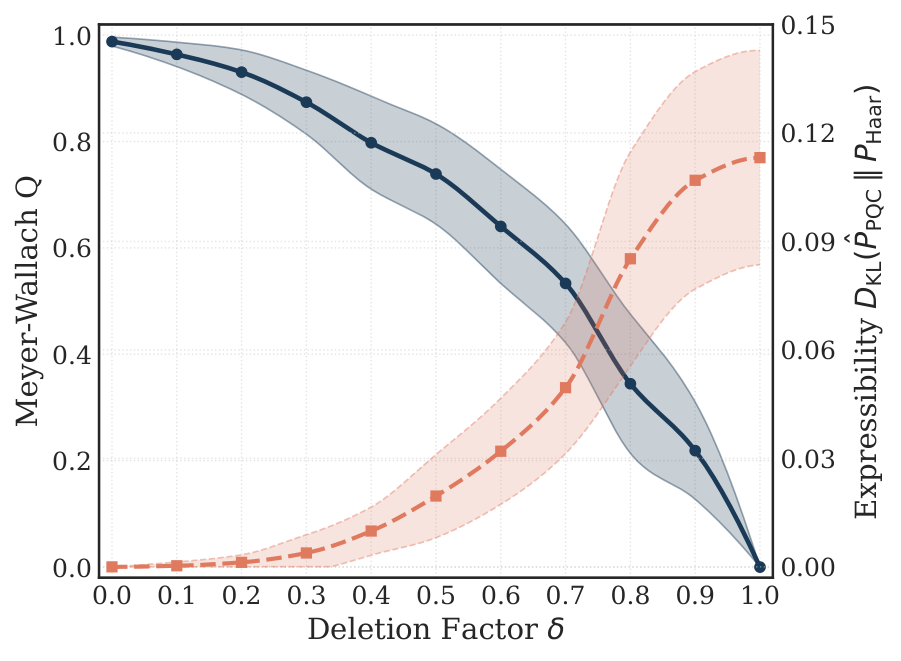
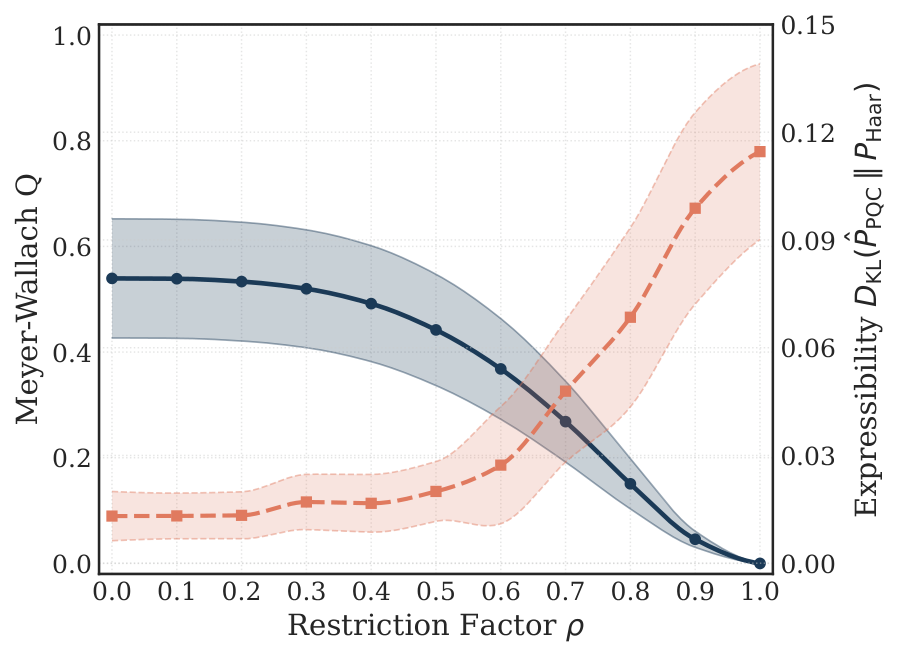
- RQ1 — Validation of entanglement controls (Sec. Results 1): both mechanisms produce monotonic, smooth control over Q; deletion δ drives Q linearly to zero, restriction ρ stays at saturation until a sharp threshold.
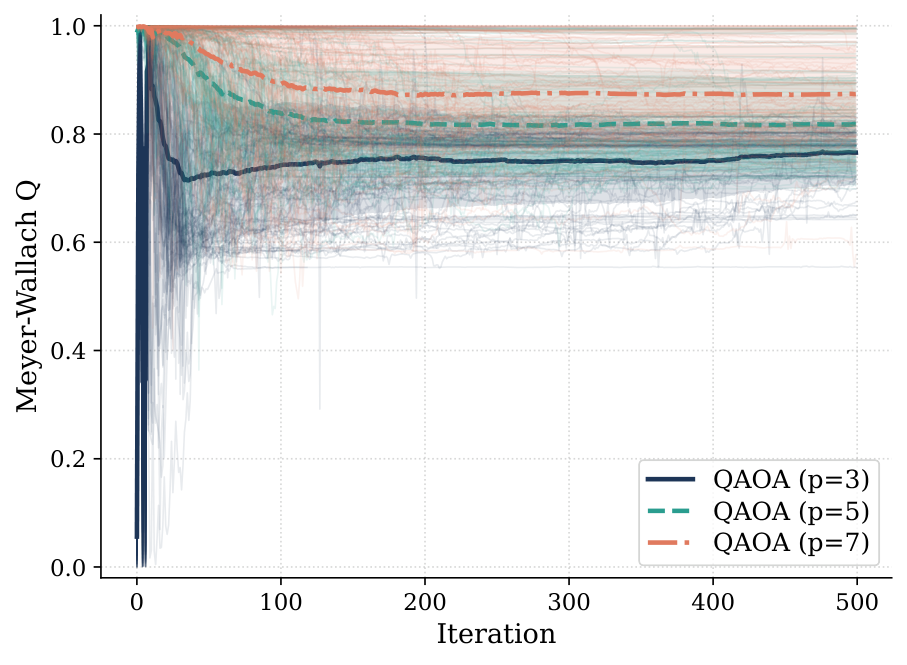
- RQ2 — Entanglement dynamics during training (Sec. Results 2): for VQE-like HEAs, mean Q(t) decreases over optimiser steps; for QAOA, Q(t) remains saturated.
- Approximation-ratio finding (Sec. Discussion): on MaxCut instances, the product-state HEA (Q = 0) reaches approximation ratios competitive with QAOA, and both exceed the Goemans–Williamson bound αGW = 0.878 on a fraction of instances. Most entangled HEAs lie strictly below.
- "Most probable bitstring" metric: looking at the highest-probability single bitstring rather than the mean approximation ratio, the gap between QAOA and product HEA shrinks — solution quality concentrates in a single mode for both.
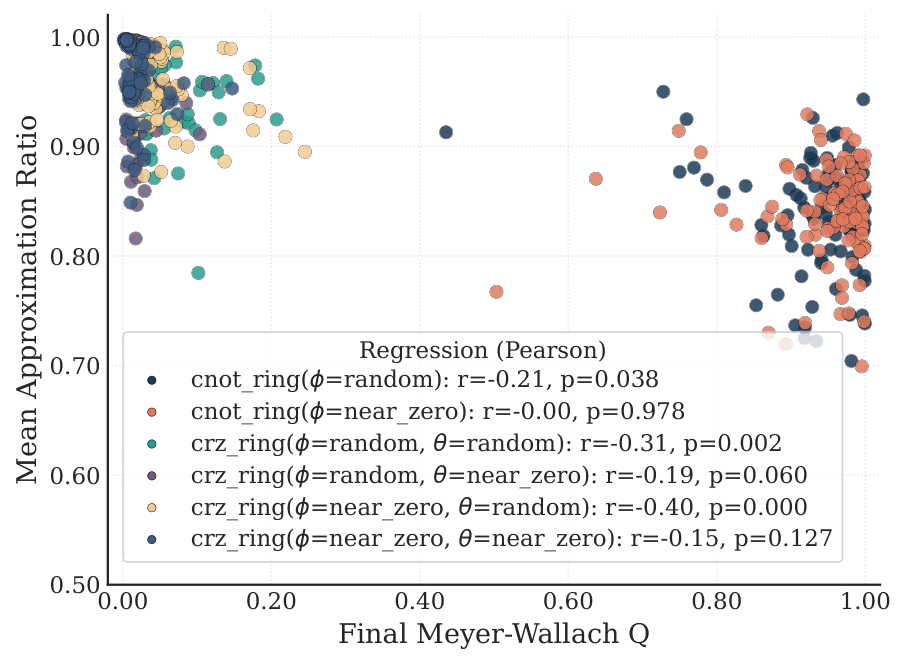
- Structural claim: across instance classes (different graph densities), the deletion-induced quality improvement is robust; an instance-level correlation analysis (final Q, peak Q, AUC of Q(t)) shows lower-Q runs systematically achieve higher approximation ratios on HEAs but not on QAOA.
Detailed walkthrough
Setup (Background). MaxCut on a graph G=(V,E) maps to a diagonal Ising cost Hamiltonian HC whose ground state is a single computational-basis bitstring — a product state. So in principle no entanglement is needed for the answer. The question the paper poses is whether during the search entanglement helps the optimiser find that product state.
Entanglement controls (Methodology). Both controls act on a standard "crz_ring" HEA: L = 3 layers of single-qubit RX, RZ rotations followed by an entangling block. (a) CNOT deletion replaces a fraction δ of CNOTs by identity, structurally removing entangling capacity. (b) CRot restriction takes a ring of variational controlled-RZ gates and clamps a fraction ρ of their angles near zero — preserving the gate's existence but suppressing its entangling action. Both are monotonic in their parameter; together they provide nearly orthogonal views of "how much entanglement does the ansatz structurally allow" vs. "how much does the optimiser actually use".
Validation (Results — RQ1). Across 100 random parameter initialisations per (δ,ρ) configuration, the Meyer–Wallach Q response is monotonic — deletion gives a clean linear drop, restriction gives a sigmoid threshold. This confirms the controls are usable knobs.
Trajectories (Results — RQ2). The central observation: when the optimiser can indirectly reduce Q via its parameters (e.g., setting CRot angles to zero), it does so. Q(t) trajectories show Q dropping monotonically with training step for all HEA configurations with adjustable entanglement; Q stays near zero for the unentangled HEA (by construction) and stays high for QAOA (also by construction — γ, β rotations preserve Q on average).
Solution quality (Discussion). Plotting mean approximation ratio against the entanglement reduction parameter, performance increases with deletion fraction — i.e. removing entangling capacity helps. The fully separable HEA outperforms every entangled HEA tested. QAOA achieves comparable approximation ratios with high Q, confirming that entanglement structure (γ-rotations encoding the cost graph) is qualitatively different from free-parameter entanglement (the optimiser cannot use entanglement that is not aligned with the cost geometry).
Limitations (Discussion — Limitations). The authors are careful: results are for MaxCut, diagonal Hamiltonians, with classical noiseless simulation; they don't (yet) extend to non-diagonal problems or NISQ noise. They also note that with only finitely many layers the HEA may simply lack the expressivity to exploit entanglement productively — though the QAOA comparison suggests that even with matched expressivity, HEAs underuse entanglement.
Implications for quantum advantage. The discussion section makes the strong claim: "HEAs for diagonal Hamiltonians are inappropriate." This sharpens prior soft warnings about HEAs in the optimisation literature (barren plateaus, optimiser-noise interaction) into a concrete, controlled demonstration. Variational approaches to combinatorial optimisation should prioritise problem-structured circuit designs — exactly the stance Y1/Y2/Y3 take.
Figures

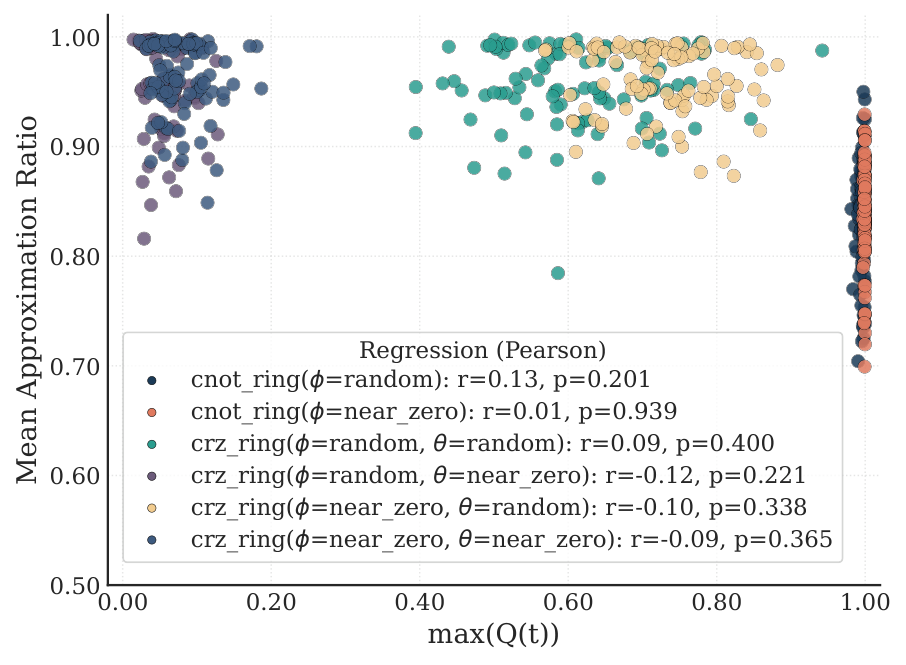
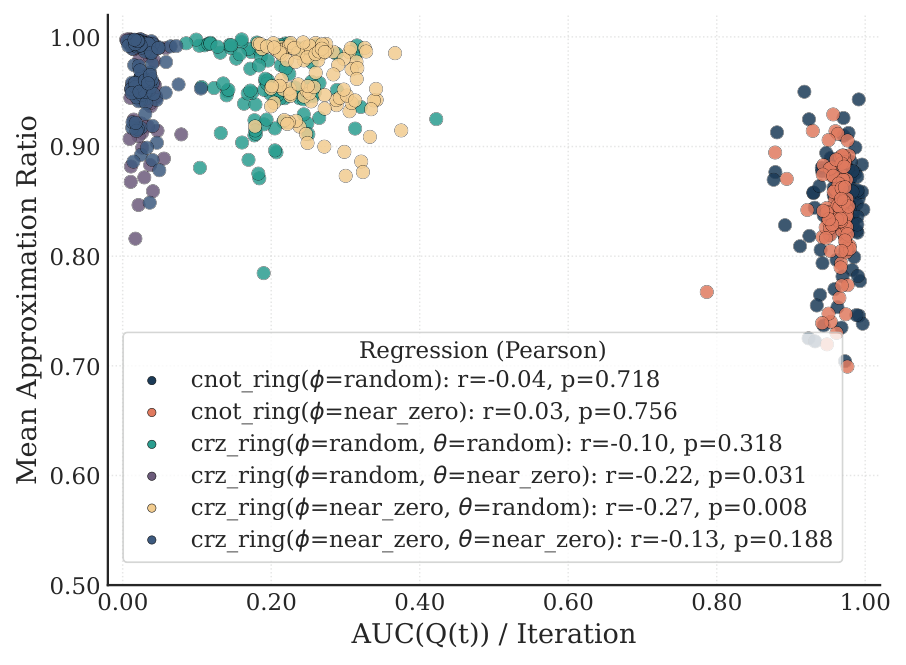
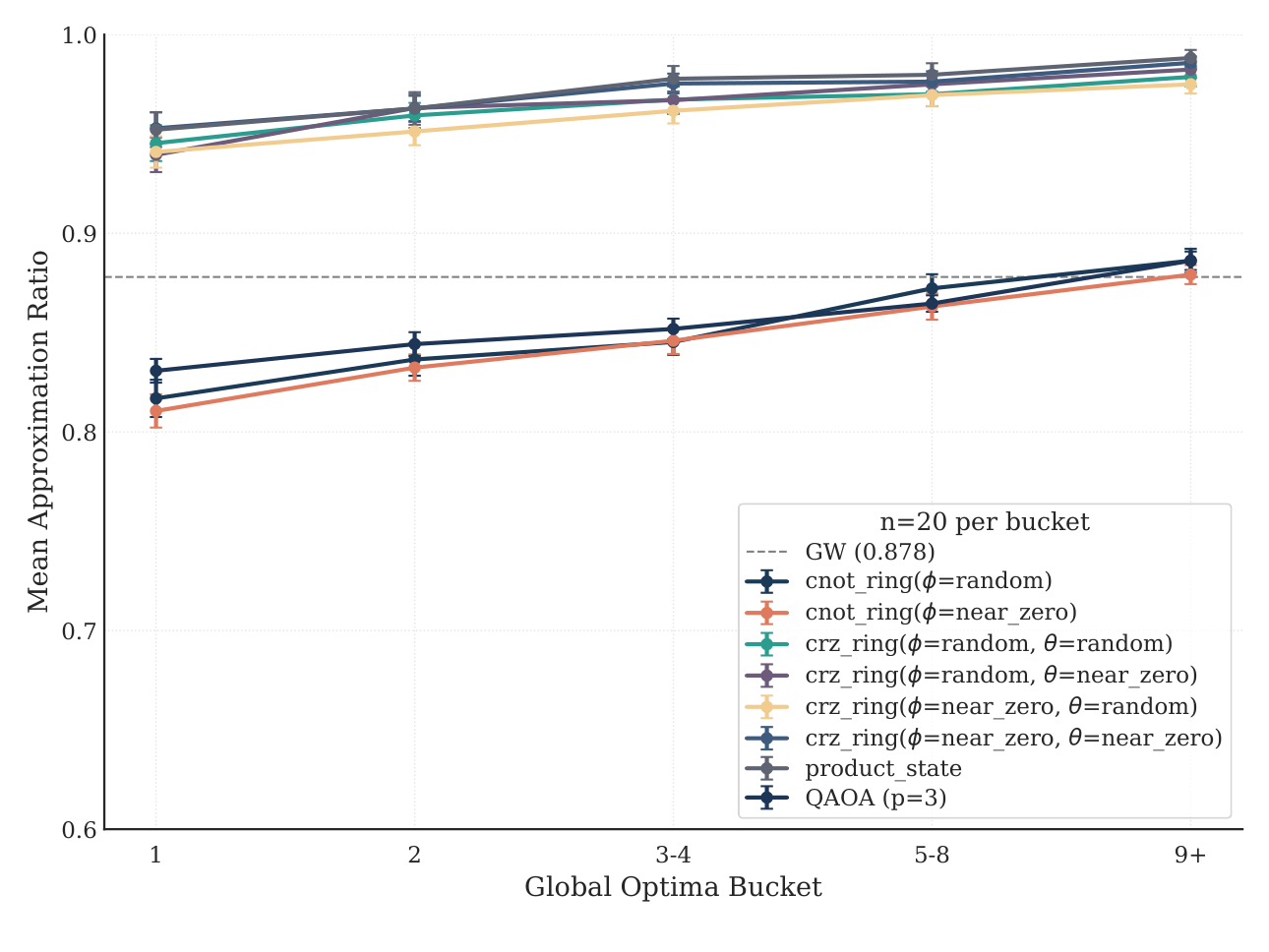
Citations to Yuan's papers
Overlap with Y1–Y6
- Y1 (warm-started iterative QAOA on 3-regular MaxCut): closest overlap — MaxCut + QAOA is exactly Y1's testbed. The paper provides empirical justification for QAOA's structural entanglement that Y1's iterative warm-start scheme builds on. A natural extension: do their Q-trajectory analyses on warm-started QAOA — does the warm start affect the trajectory? Likely yes; this could be a clean follow-up paper.
- Y2 (quasi-binary + hard XY mixer): reinforces Y2's design philosophy — problem-structured ansatz beats hardware-efficient one. The paper would cite well here.
- Y3 (DGMVP QAOA + dual annealing): the discussion of QAOA's structural entanglement supports Y3's defence of QAOA over generic VQAs for portfolio problems. The product-state baseline result is also worth checking against the DGMVP problem.
- Y4 / Y5 / Y6: limited direct overlap — Y4 is Grover-based, Y5 is SDP/dequantisation, Y6 is foundations. The Goemans–Williamson bound reference in their plots is the only thread to Y5.
Recommended action for Yuan
- Cite in any future QAOA-vs-HEA framing: this paper is the cleanest controlled-experiment evidence that HEAs underperform problem-structured ansätze on diagonal Hamiltonians. Useful citation for the "why QAOA, not HEA" argument in Y3 follow-ups.
- Replicate on warm-started QAOA: run their Q(t) trajectory analysis on Y1's iterative warm-start scheme — does warm-starting collapse Q faster or slower than a cold start? Either result is interesting.
- Adapt CRot/CNOT-deletion controls as ablation knobs for Y2-style hard-mixer ansätze: how much of the mixer's entangling action is necessary, and is there a Fourier-LCU-style approximation (cf. 2605.18985 the same day) that achieves the same with less?