Constrained Counterdiabatic Quantum Approximate Optimization Algorithm for Portfolio Optimization
Abstract
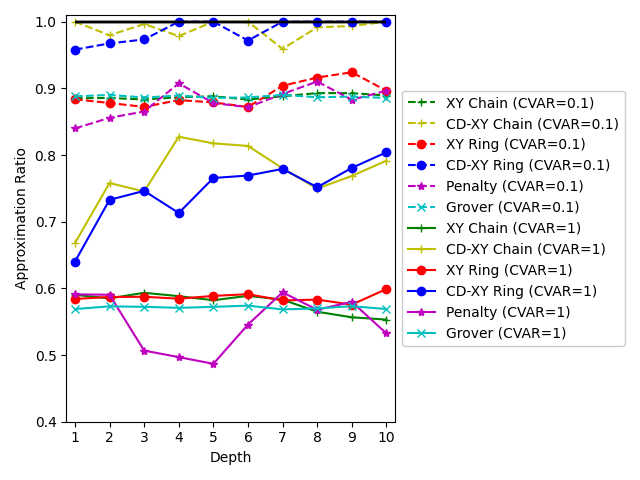
We introduce a counterdiabatic (CD) extension of the Quantum Approximate Optimization Algorithm (QAOA) for constrained portfolio optimization. By incorporating approximate adiabatic gauge potentials generated from nested commutators of the Ising-type portfolio problem Hamiltonian and the Hamming weight-preserving XY mixer Hamiltonian into our variational ansatz, the resulting Constrained Counterdiabatic QAOA (CCD-QAOA) achieves improved optimization performance under realistic budget and risk constraints. Benchmarking against standard XY-mixer QAOA, Grover-mixer QAOA, and penalty-based QAOA formulations, our numerical simulations demonstrate that, for a fixed QAOA depth, our CCD-QAOA approach consistently results in better approximation ratios.
Executive summary
This paper sits squarely on Yuan's portfolio×QAOA axis and combines the two most relevant ingredients of Y2/Y3 with a third (counterdiabatic/Sels-Polkovnikov gauge-potential) extension. The authors take the Markowitz mean-variance objective with a fixed-cardinality (budget) constraint, encode it as an Ising-type cost Hamiltonian, restrict the dynamics to the Dicke subspace via an XY (Hamming-weight-preserving) mixer, and then add a variational adiabatic gauge potential (AGP) truncated at three-body Pauli strings. The headline empirical claim is that at fixed circuit depth this CCD-QAOA dominates plain XY-mixer QAOA, Grover-mixer QAOA, and penalty-based QAOA in approximation ratio across CVaR thresholds. The three-body CD terms break exact feasibility (Hamming weight no longer preserved) and so the success probability story is more nuanced — but the cost-expectation metric improves.
Main contribution
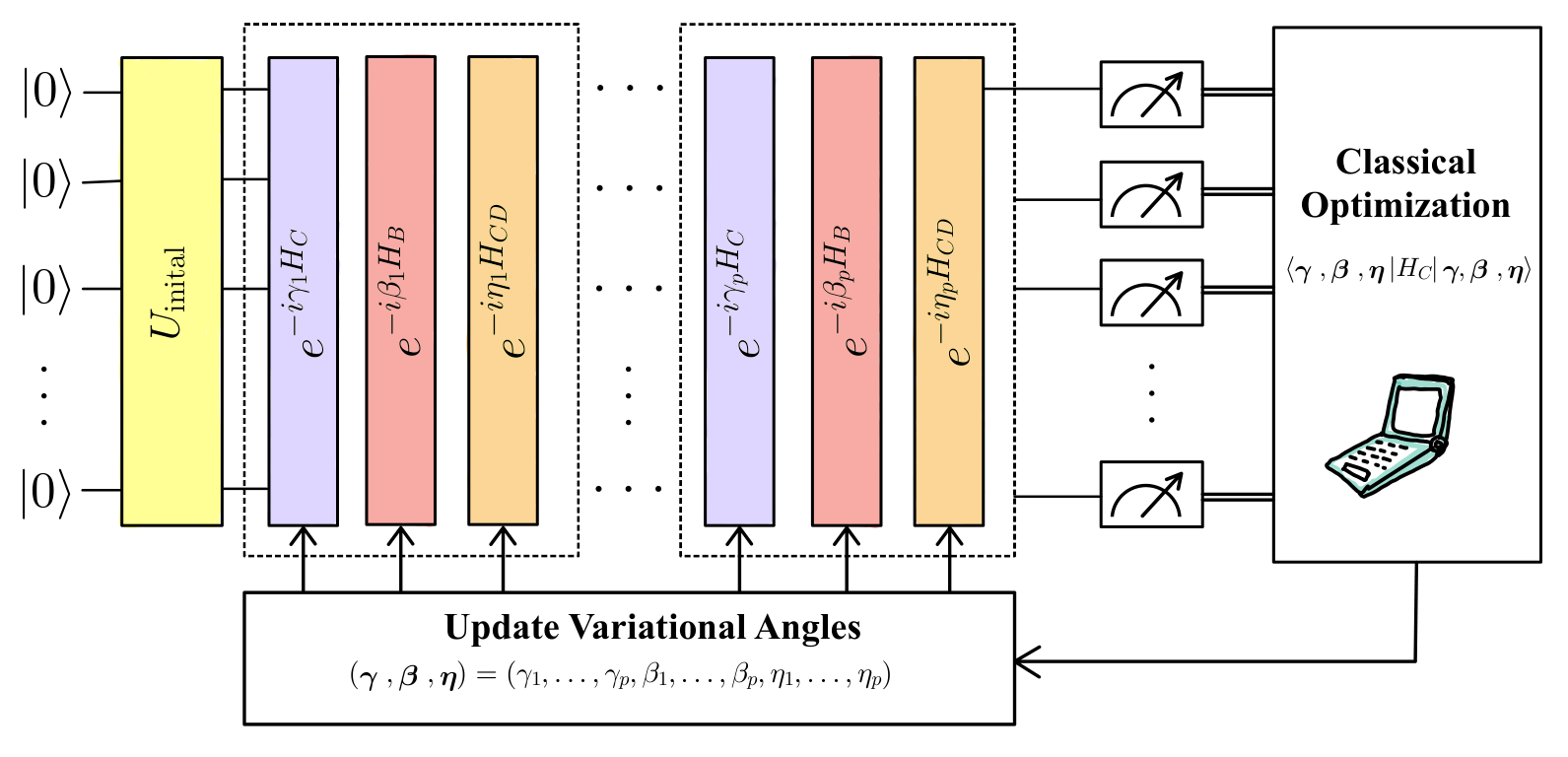
The paper's contribution is a systematic, problem-structured construction of an approximate AGP operator pool for constrained portfolio QAOA. The authors show that the nested commutator of the portfolio Ising Hamiltonian H_C = Σ J_ij Z_iZ_j + Σ h_i Z_i with the XY mixer H_M^XY = Σ_{i<j}(X_iX_j + Y_iY_j) naturally generates two-body X_iY_j − Y_iX_j terms (already inside the XY algebra) and three-body X_iY_jZ_k − Y_iX_jZ_k strings. Truncating the gauge-potential ansatz A_λ* to this two- plus three-body pool and fitting the coefficients {α_ij, β_ijk} by minimizing the Hilbert-Schmidt action S = Tr[(∂_λ H + i[A_λ, H])²] yields a linear system, which they integrate into a standard QAOA depth-p circuit by appending e^{−i η_k H_CD} after each (cost, mixer) layer.
Key theorems / lemmas / algorithms
- CCD-QAOA ansatz (Eq. for
|ψ_CD⟩): a depth-p circuit applying e^{−iγ_k H_C} · e^{−iβ_k H_M^XY} · e^{−iη_k H_CD} to the Dicke state |D^N_B⟩. - Gauge-potential commutator structure: closed-form derivation that
[Z_iZ_j, X_iX_k+Y_iY_k] = 2i(Y_iX_k − X_iY_k)Z_j, motivating the three-body operator pool. - Variational AGP equations:
M_{kl}c_l = v_kwithM_{kl} = −Tr([O_k,H][O_l,H])andv_k = i Tr(O_k[H, ∂_λ H]), fixing the coefficientsα_ijandβ_ijkfrom problem operators only. - Approximation-ratio benchmark:
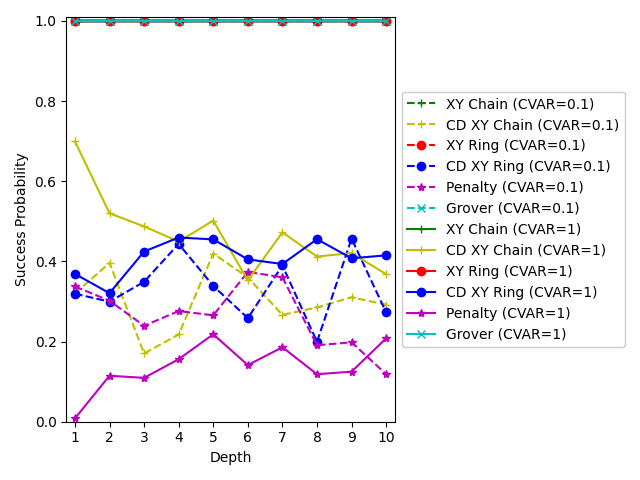
r = (⟨H_C⟩ − E_max)/(E_min − E_max)measured against three baselines (XY chain, XY ring, Grover-mixer, penalty) across CVaR α values. - Empirical observation on feasibility leakage: the three-body CD generators are not Hamming-weight-preserving, so CCD-QAOA trades some success probability P_GS for higher cost expectation — explicitly acknowledged and analyzed.
Detailed walkthrough
Section II of the paper builds the standard QAOA scaffolding and motivates constraint-preserving mixers via the classic Hadfield–Hadfield Quantum Alternating Operator Ansatz lineage. The portfolio cost (Section II.C) is the textbook Markowitz objective C(x) = λ Σ Σ_ij x_i x_j − Σ μ_i x_i with budget Σ x_i = B; after the Z-substitution x_i = (1 − Z_i)/2 it becomes a dense fully-connected Ising Hamiltonian. The penalty route is rejected because large α values distort the spectrum and shrink effective gaps, while the alternative (constraint-preserving mixer) keeps the dynamics inside the Σ x_i = B subspace at the price of needing a structured mixer.
Section III is the technical heart. The authors recall Sels–Polkovnikov-style variational gauge potentials: A_λ ≈ Σ α_k(λ) O_k with operator pool {O_k} determined by minimizing the Frobenius norm of G(A_λ) = ∂_λ H_AD + i[A_λ, H_AD]. The choice of pool is constrained by what commutators between H_C and H_M^XY generate. Their derivation (Eqs. for [Z_iZ_j, X_iX_k+Y_iY_k]) shows that the leading-order operators are three-body X_iY_kZ_j − Y_iX_kZ_j. Crucially they include both the two-body XY-algebra generators and the three-body strings — capturing what they call "correlated excitation transport conditioned on the state of neighboring qubits".
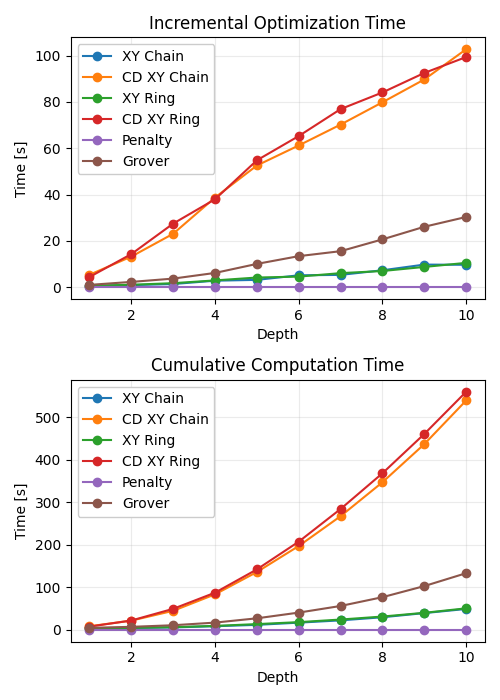
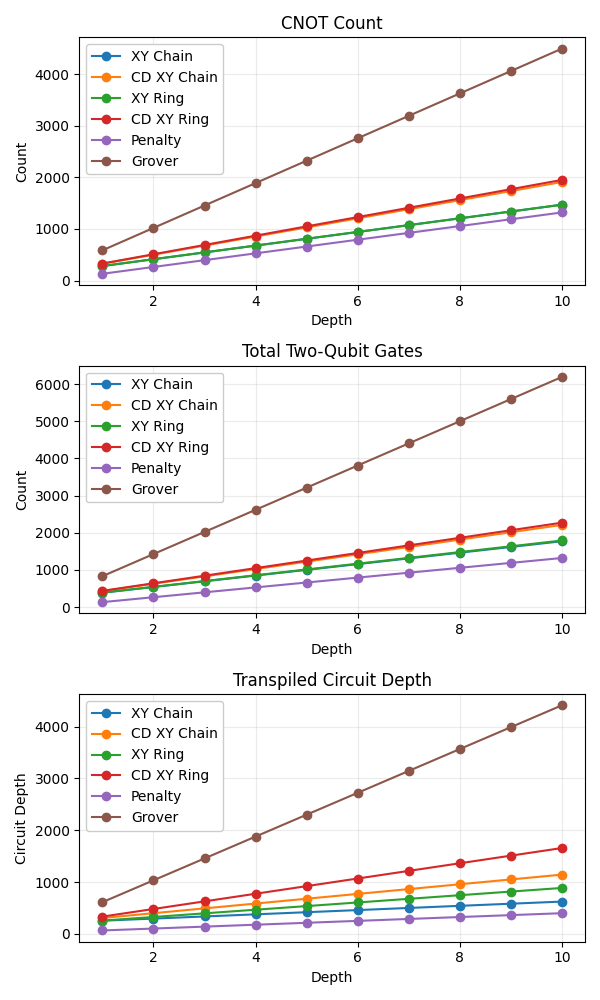
Numerical results (Section IV) use Qiskit Finance to generate dense PSD covariance matrices for N=12 assets, with budget B=4, optimized via OpenQuantumComputing's QAOA augmented with their CD routine. The CVaR-QAOA cost (Barkoutsos et al.) replaces the mean of the sampled cost with the conditional expectation of the lower α-quantile, which the figures benchmark across several α values. The headline plot (Fig. approxratio.png) shows CCD-QAOA dominating at every p, especially at low CVaR (small α — the most informative regime since the diagonal optimum is a basis state). The Grover-mixer baseline is the second-best in approximation ratio but pays the heaviest gate cost (Fig. metrics.png: CNOT count and transpiled depth scale dramatically with p).
The honest caveat in Section IV: while pure XY-mixer QAOA has P_GS = 1 trivially because every sampled bit-string is feasible, CCD-QAOA's three-body generators leak amplitude outside the Hamming-weight subspace. P_GS for CCD-QAOA is therefore lower than for pure XY-mixer but still substantially higher than for penalty-based QAOA — consistent with the broader Y3 finding that CVaR-style cost statistics can be a more honest figure of merit than success probability for dense portfolio Hamiltonians.
Section V's discussion connects the result back to a general principle: constrained combinatorial optimization problems have structured operator algebras (the commutator of H_C and the mixer) that determine which gauge-potential operators are physically required. The authors note this should generalize to other fixed-cardinality problems (scheduling, routing, cardinality-constrained QP), which is directly the territory of Yuan's Y4. They explicitly flag ADAPT-QAOA and warm-starting as natural next steps for trimming the three-body operator pool — both being avenues Yuan has explored.
Figures
Citations to Yuan's papers
Overlap with Y1–Y6
- Y2 (quasi-binary portfolio QAOA, arXiv:2304.06915): very strong overlap on scope (constrained portfolio QAOA) and method (hard constraint-preserving mixer with no penalty term, CVaR-QAOA, iterative refinement). Y2 uses a quasi-binary encoding of ~2log₂(U−L+1) qubits per asset with a Hamming-weight-preserving mixer; this paper uses a binary one-asset-per-qubit encoding with the canonical XY mixer plus a CD correction. The encoding is different but the architectural choices (no penalty, hard mixer, CVaR) are identical.
- Y3 (QAOA DGMVP, arXiv:2410.16265, QST 2026): strong scope overlap on end-to-end QAOA for portfolio optimization. Y3 focuses on the noise regime crossover (thermal relaxation precludes advantage; shot-noise regime is favourable) and on layerwise + dual-annealing optimization — orthogonal to but compatible with the CD operator-pool construction here. CCD-QAOA would be a natural ablation to add to Y3's noise-resource scan.
- Y1 (iterative warm-started QAOA, arXiv:2502.09704): method-adjacent. Y1's warm-starting via measurement-based iteration is exactly what the authors flag in Section IV as the obvious mitigation for CCD's increased optimization runtime. They cite kordonowy_lie_2025 and bucher_constrained_2026 for warm-starting but not Y1.
- Y4 (Grover + ADMM cardinality-constrained BO, arXiv:2603.14744): scope overlap (cardinality-constrained binary optimization on a fixed-Hamming-weight subspace). The mention of Grover-mixer QAOA as a baseline is direct contact — the paper would be a useful comparator for Y4's Grover sqrt(C(n,k)/M) scaling claim once depth-cost is normalized.
- Y5, Y6: no overlap.
Recommended action for Yuan
- Cite and contrast in the next portfolio-QAOA draft. This is the clearest "same problem, adjacent method" paper of the cycle. CCD-QAOA's three-body CD operator pool is a natural ansatz extension to add to the Y3 layerwise + dual-annealing pipeline. The omission of Y2/Y3 from their bibliography is also worth a friendly outreach.
- Email the authors (Falla, Safro at Delaware). A reciprocal-cite note pointing them at Y2 (quasi-binary encoding alternative to one-hot), Y3 (DGMVP noise-regime baseline), and Y1 (warm-starting as a concrete remedy for the optimization-overhead issue they identify in Section IV) is low-cost and high-signal — they are in this exact problem space.
- Implement a head-to-head ablation. Compare CCD-QAOA at p=1,2,3 against Y3's layerwise QAOA on the same Qiskit Finance instances at N=12, B=4 to quantify whether the CD overhead beats simply going one layer deeper.