Finite Imaginary-Time Evolution for Polynomial Unconstrained Binary Optimization
Abstract
Imaginary-time evolution is a standard primitive for ground-state preparation but is nonunitary, precluding direct quantum implementation. We develop Finite Imaginary-Time Evolution (FinITE), a finite-β construction for diagonal Pauli-Z cost Hamiltonians arising from polynomial unconstrained binary optimization (PUBO) instances, including QUBO and HUBO cases. FinITE uses the linear-combination-of-unitaries (LCU) framework to implement a scaled imaginary-time propagator. The commuting Pauli-Z structure makes termwise block-encodings compose without product-formula error, and higher-order Pauli-Z terms are handled directly without quadratization. The structure yields an exact finite-β identity between the LCU success probability and the ground-subspace fidelity. Combined with a gap-based fidelity lower bound, the identity yields a closed-form sufficient imaginary-time threshold β* for a chosen target fidelity. Statevector simulations verify the identity on a five-vertex MaxCut (QUBO) and an eight-qubit cubic HUBO instance.
Executive summary
FinITE is a clean, analytically-tight LCU+amplitude-amplification implementation of imaginary-time evolution specifically for the diagonal commuting-Pauli Hamiltonians of (P/QUBO/HUBO) optimisation. The headline analytic result — Proposition 1 — is an exact identity PLCU(β)·Fg(β) = γ0·e−2β(W+E0) linking LCU success probability and ground-subspace fidelity to a single exponential envelope, given the initial-state overlap γ0 and the Pauli-decomposition ℓ1-norm W. From this they derive a closed-form sufficient β*(F̄) for any target fidelity F̄. The benchmark numerical demonstration uses MaxCut (Y1's testbed) and a cubic HUBO (Y2/Y4-flavoured higher-order constrained) instance — overlap with Yuan's portfolio is on the conclusion side: another quantum end-to-end primitive for the same QUBO/HUBO Hamiltonians Y3 cares about, but bypassing the QAOA optimisation loop entirely.
Main contribution
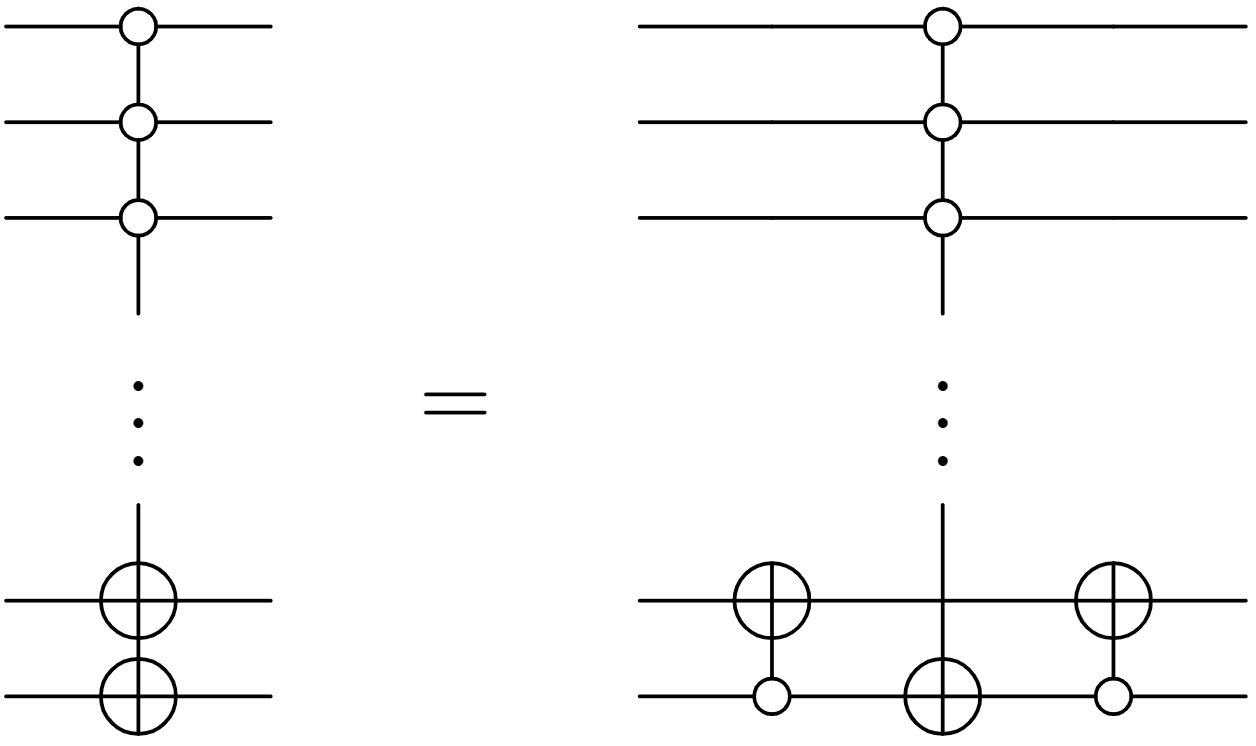
For commuting diagonal Pauli-Z Hamiltonians H = Σ xμσμ, FinITE implements a finite-β block-encoding of m(β)·e−βH with subnormalisation m(β) = e−βW. Each Pauli term gets its own LCU block; commutativity makes the joint product exact (no Trotter error) and avoids quadratization for ≥3-local terms. The exact spectral identity (Eqs. 5–7) gives both a state-dependent expression for PLCU(β) tighter than the textbook Childs–Wiebe bound and a corollary β*(F̄) for sufficient imaginary time. Fixed-point amplitude amplification is then applied to the LCU-success subspace (which is known a priori — the all-zero ancilla outcome) with explicit query bound L = O(log(2/δ)·eβ*(W+E0)/√γ0).
Key theorems and corollaries
- Proposition 1 (Exact identity, Sec. III.A): for any commuting diagonal-Z Hamiltonian and any initial state, PLCU(β) Fg(β) = γ0 e−2β(W+E0), with individual spectral expressions PLCU(β) = e−2βW Σ |ck|² e−2βEk and Fg(β) = γ0·e−2βE0/(Σ |ck|² e−2βEk).
- Corollary 1 (Gap bound on fidelity): Fg(β) ≥ γ0/(γ0+(1−γ0)e−2βΔ), with Δ = first-excited gap.
- Corollary 2 (Sufficient β*): β*(F̄) = (1/2Δ)·log(F̄(1−γ0)/(γ0(1−F̄))) suffices for Fg(β) ≥ F̄.
- FPAA query bound (Eq. 13): L = O(log(2/δ)·eβ*(W+E0)/√γ0) at the fidelity threshold.
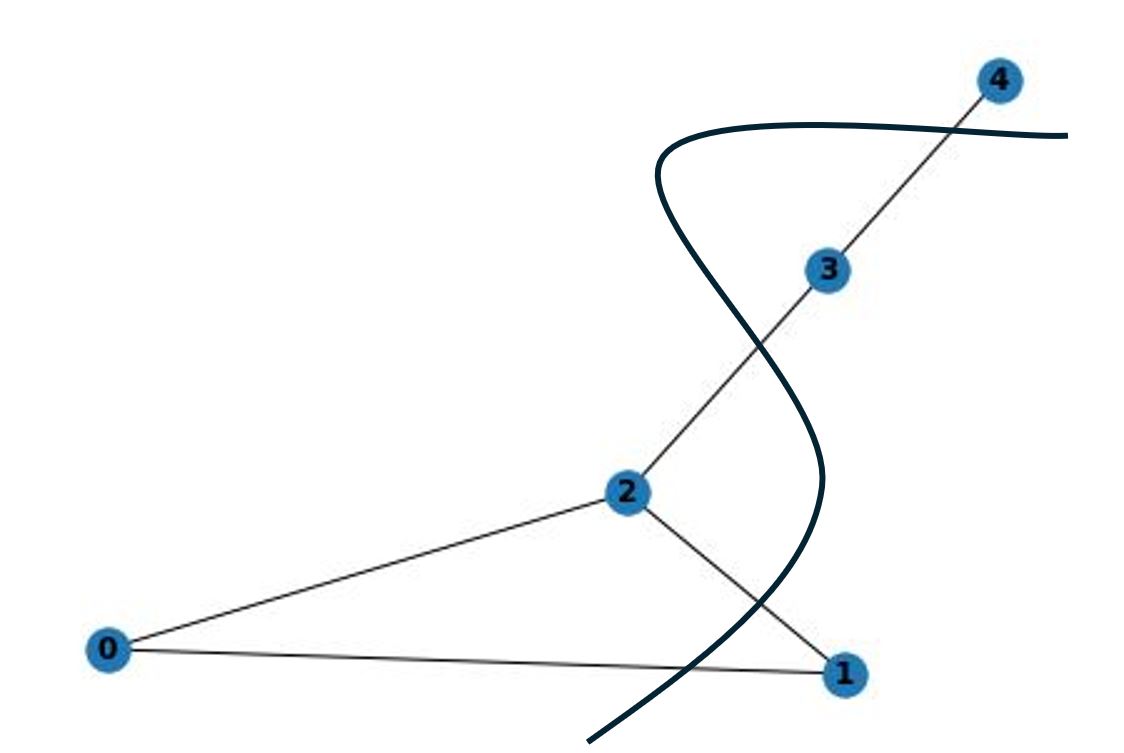
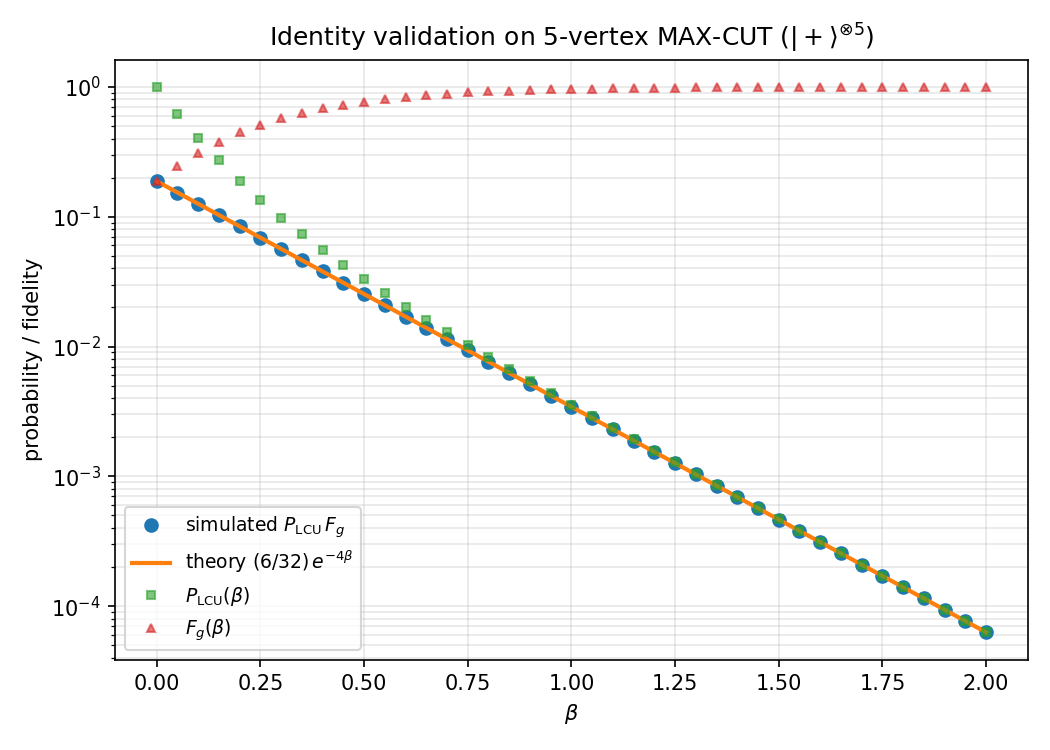
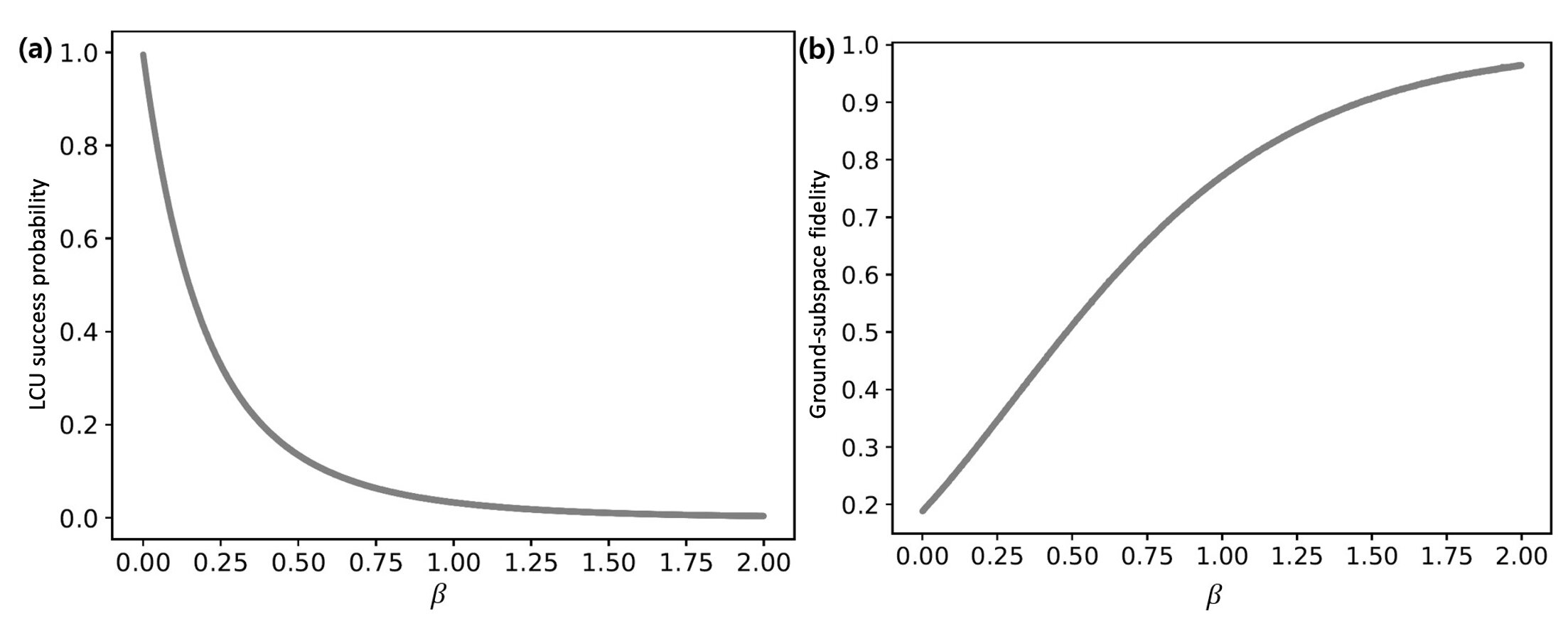
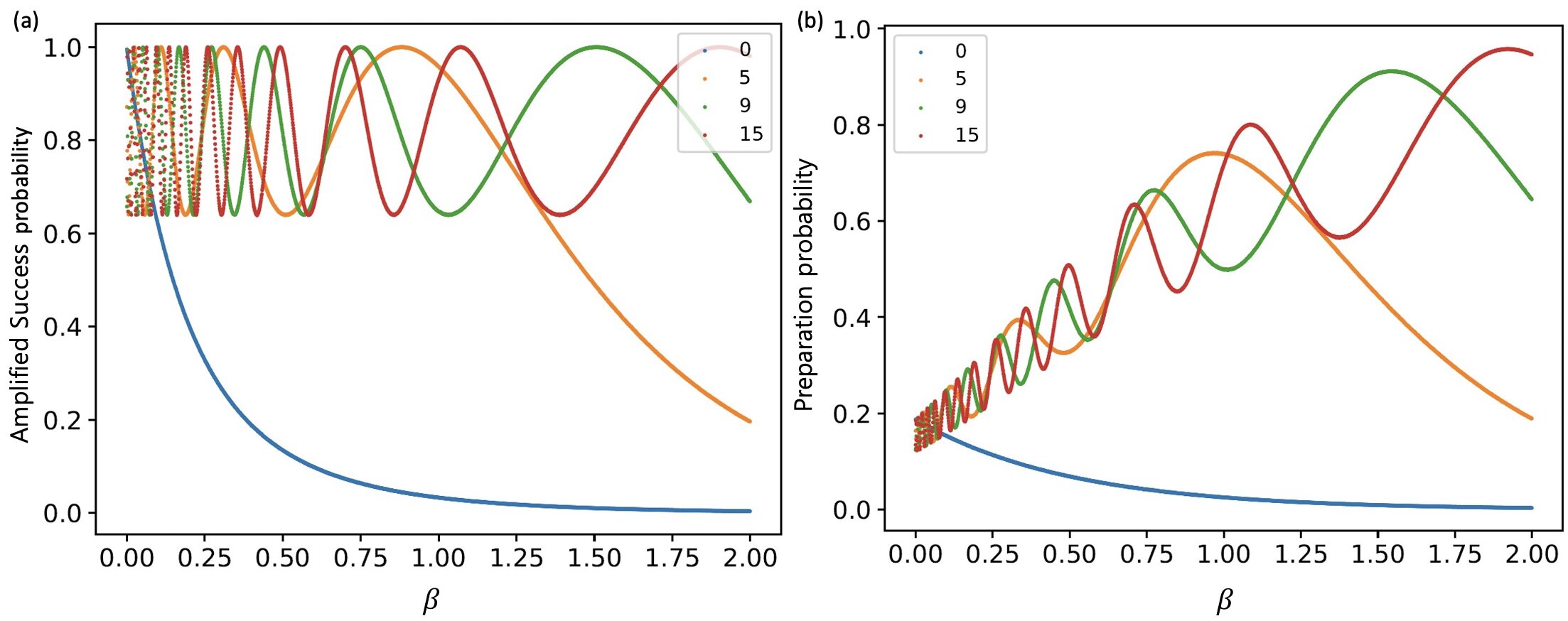
- MaxCut benchmark (Sec. IV.A): on the 5-vertex non-bipartite test graph, PLCU·Fg = (3/16)e−4β matches simulation to relative error 1.3×10⁻¹⁴; with FPAA at L=15, Pg(L) approaches unity for β > β*(0.98) ≈ 1.34.
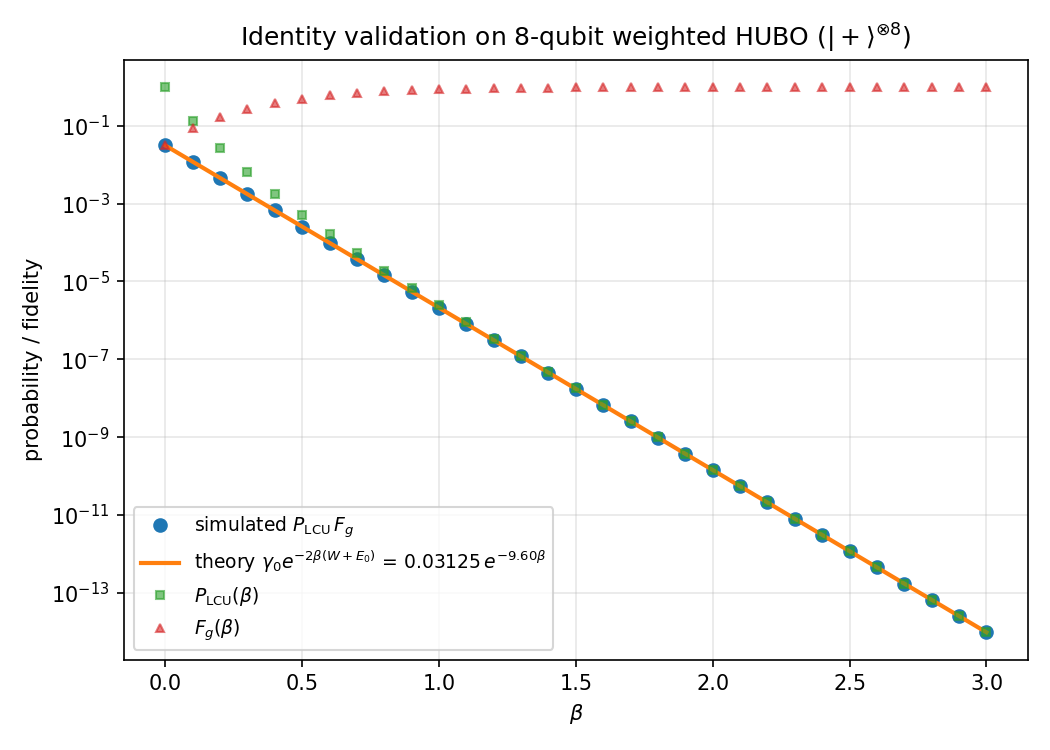
- HUBO benchmark (Sec. IV.B): 8-qubit cubic Pauli-Z instance with W=11.4, E0=−6.6, |G|=8, Δ=1.2; identity verified across three γ0 regimes (uniform 0.031, warm-start p=0.6 0.041, warm-start p=0.85 0.29) to relative error 1.2×10⁻¹².
Detailed walkthrough
Imaginary-time evolution e−βH is the canonical ground-state-preparation primitive but is nonunitary; the standard quantum implementations are VITE (variational), QITE (local-unitary patching), and PITE (probabilistic via ancilla measurement). FinITE belongs to the LCU/block-encoding family but specialises hard to the commuting-Pauli case. Section II reviews the LCU primitive and FPAA basics. Section III is the analytic core.
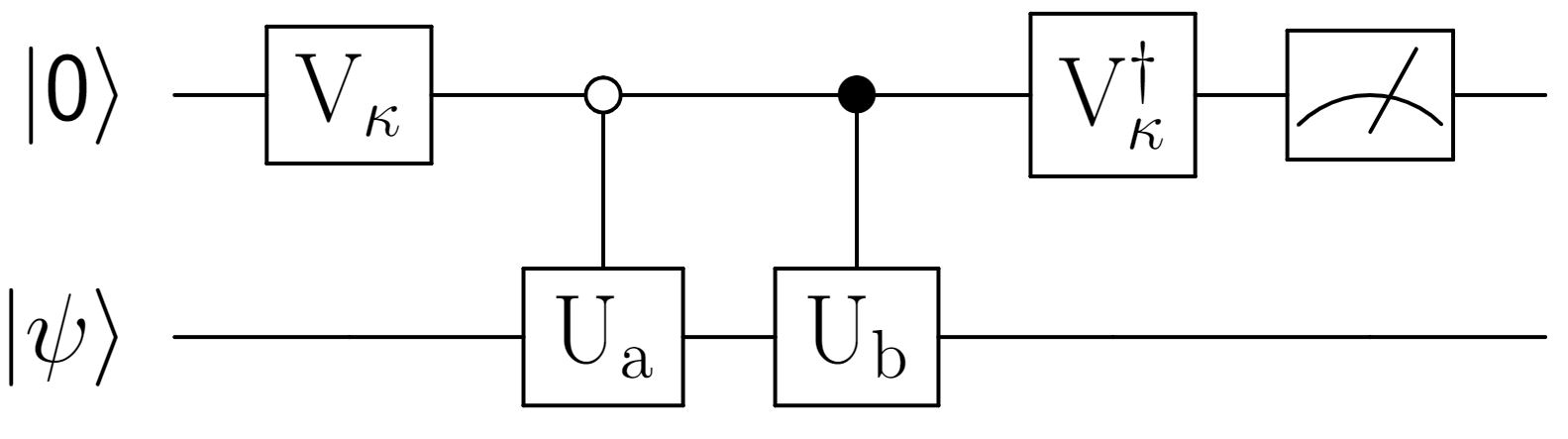
The construction (Sec. III.A) writes e−βH as a product of single-Pauli factors e−βxμσμ; commutativity means the product is exact. Each factor is block-encoded as a two-term LCU with κμ=coth(β|xμ|), Ua=I, Ub=−sgn(xμ)σμ. The subnormalisation per term is eβ|xμ|, so the total subnormalisation is αLCU(β) = eβW, with W the Pauli ℓ1-norm. The β→∞ limit (Eq. 9) collapses to a projector onto states satisfying every individual Pauli-eigenvalue sign constraint — useful only for bipartite-MaxCut-like instances where the ground state saturates the triangle inequality E0=−W. For generic instances E0 > −W, the limiting subspace is empty or exponentially small, motivating the finite-β construction.
The exact identity Proposition 1 is the paper's central analytic statement. Its derivation (Appendix C) is short — eigenbasis expansion of PLCU = ‖M̂(β)|ψ0⟩‖² and Fg(β) = ‖ΠGe−βH|ψ0⟩‖²/‖e−βH|ψ0⟩‖² — but the consequences are substantial. The product PLCU·Fg decays purely exponentially in β with a single rate 2(W+E0); the prefactor γ0 is the initial overlap. Crucially, the paper cleanly separates the two cost factors: the exponent W+E0 is set by the Hamiltonian, while γ0 is controllable by the initial state. This separation is exactly the warm-start lever Y1 exploits.
Corollary 2 gives a closed-form β*(F̄) for any target fidelity, depending only on the spectral gap Δ and γ0. The β* rule is operationally honest: it requires lower bounds on both, which the authors note generally need classical preprocessing or auxiliary quantum subroutines. The "warm-start regime γ0 ≳ 1/2" remark (Sec. III.B, regime (i)) is precisely the regime Y1's iterative warm-starting targets — small β* with large fidelity. The "adversarial regime γ0→0" matches the worst-case for any post-selection ITE, and is presented as an information-theoretic barrier rather than a methodological deficiency.
The MaxCut benchmark (Sec. IV.A) uses a 5-vertex non-bipartite graph with E0=−3, |G|=6, Δ=2, γ0=3/16, predicting PLCU·Fg = (3/16)e−4β. Statevector simulation confirms the prediction to relative error ~10−14. Shot-based qasm-simulator runs (10³–10⁵ shots/β) demonstrate the trade-off: PLCU falls and Fg rises along the predicted single envelope. Turning on FPAA at L ∈ {0,5,9,15} produces the expected Chebyshev oscillations in Pamp, with L=15 widening the β-range over which Pg(L) ≈ 1 to include β*(0.98) ≈ 1.34.
The HUBO benchmark (Sec. IV.B) is the more interesting test for Yuan's purposes. The 8-qubit cubic Pauli-Z Hamiltonian (Eq. 14) has 4 cubic Z-Z-Z parity terms and 4 quadratic Z-Z bridges, structurally similar to Max-3-XORSAT / Max-3-SAT instances and to the kinds of higher-order interactions that arise in cardinality-constrained portfolio formulations after auxiliary-variable elimination. The identity envelope (1/32)e−9.6β matches simulation to ~10−12. Crucially, the warm-start sweep (Fig. 8) shows that boosting γ0 from 0.031 to 0.29 raises the entire envelope by an order of magnitude — directly visualising Y1's mantra that warm-starting is the cheap lever.
The discussion (Sec. V) flags two follow-on directions: (i) proof-of-concept on real QPUs at small problem size (the M-ancilla LCU plus FPAA overhead is a real cost on current hardware); (ii) problem-specific warm-start strategies — exactly Yuan's research programme. The HUBO direct treatment without quadratization is a non-trivial advantage: Y2's quasi-binary encoding for portfolio uses higher-order interactions, and FinITE could in principle handle those without the auxiliary-variable explosion.
Figures

Citations to Yuan's papers
Overlap with Y1–Y6
- Y1 (iterative warm-started QAOA, MaxCut, DGMVP scaling): Strong overlap on the warm-start mechanism. The HUBO benchmark sweep over γ0 ∈ {0.031, 0.041, 0.29} directly demonstrates that initial-state overlap is the dominant cost lever — the same observation that motivates Y1's measurement-based iterative warm-starting. MaxCut is a shared testbed.
- Y2 (quasi-binary portfolio, hard mixer): Y2's quasi-binary encoding produces higher-order Pauli-Z interactions; FinITE's direct treatment of HUBO without quadratization is exactly the primitive Y2's encoding needs to avoid the auxiliary-variable explosion of Rosenberg's gadget. Mid-overlap on method.
- Y3 (DGMVP portfolio, layerwise QAOA, NISQ noise): FinITE is an alternative end-to-end primitive for the same QUBO/HUBO Hamiltonians Y3 targets via QAOA. The closed-form β*(F̄) is the FinITE analogue of Y3's layerwise-optimisation parameter rule.
Recommended action for Yuan
- Implement FinITE for DGMVP (Y3) on a small instance: Y3's DGMVP QUBO is a perfect benchmark — directly compare the FPAA query cost L = O(log(2/δ)·eβ*(W+E0)/√γ0) against Y3's QAOA shot-noise scaling. If γ0 can be lifted by Y3's classical-preprocessing warm starts, FinITE could match or beat layerwise QAOA at small problem sizes.
- Test on Y2's HUBO portfolio formulation: Y2's quasi-binary encoding produces higher-order terms; FinITE handles them natively. Quantify the W and E0 for a 6–8 asset DGMVP instance under quasi-binary encoding to estimate the FinITE FPAA query cost.
- Email the authors: Park (Yonsei) and Huh (Yonsei Chemistry) work on quantum chemistry / optimisation primitives; this is a clean hook for collaboration. The explicit decomposition β*(F̄) + warm-start γ0 structure invites a Yuan-style measurement-based iterative warm-start extension.